In the previous about Kensington Gardens, I mentioned the Great Exhibition of 1851 which was held in Hyde Park. And it deserves an article in its own right. Today we can see some similar large edifices around the world designed to hold big exhibitions. Some are spectacular, but the building that was built to house the Great Exhibition was truly amazing for its time and even today, it would raise eyebrows.
The exhibition was known officially as the “Great Exhibition of the Works of all Nations.” It was the time when the British Empire was nearing its peak and the country, or at least some of the people in power, wished to show the world just how great Britain was. The original idea came from a man by the name of Henry Cole who was the Assistant Keeper at the Public Records Office. But he also received help and backing from a powerful ally, Prince Albert, the husband of Queen Victoria.
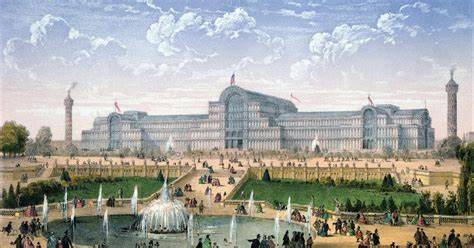
When the building project was put out for ideas and tenders, there were 230 applications. The idea which won consisted of a huge building which resembled a giant greenhouse. Designed by Joseph Paxton, it measured 1,848 feet long by 454 feet wide. It was also so high that when built it was able to enclose a number of the park’s trees within it. The structure became known as the Crystal Palace.
When it opened, it attracted thousands of people who came to see the 1,300 exhibits from Britain and around the colonies of the time. The items on display were an eclectic collection to say the least. They included the world’s largest diamond and the world’s biggest pearl. There was also a knife with 300 blades. What you could use all of them for defies imagination, but I would love to see it. There were also a range of scientific instruments and firearms as well as many other items of interest.
The exhibition was opened by Queen Victoria on the 1st May 1851 and she remained there for over five-and-a-half hours looking at the exhibits. She was obviously amused! Besides the general public, many notable names also made their way to the palace. They included Charles Darwin of evolution fame and the writers Charlotte Bronte and Lewis Carrol, the author of Alice in Wonderland.
It was always meant to be a temporary structure and so, the following year it was dismantled. However, the plan was not to destroy it but to move it. And it was rebuilt in the area of Streatham Hill in south London. When complete, the building influenced the change of name from Streatham Hill to Crystal Palace, a place and name that still exists of course. The building’s use turned to more of a theme park for the Victorians to enjoy. It was still going well up until 1936 when it caught fire. The structure was completely destroyed and was never rebuilt. Today, there is an athletics track on the site as well as a park with some dubious stone dinosaurs on show.
 John Pullen