During the 1930s most of us are aware of the rise of the far right in Germany in the form of the Nazi Party. Adolf Hitler was their leader and as we all know, it led to the breakout of World War II in 1939 until Germany lost in 1945. But Germany was not the only country to feel the rise of the far right.
In Britain at the time, the fascists appeared in the form of the Black Shirts, although their official title was the British Union of Fascists. Their leader was a man by the name of Oswald Mosely. They often featured in the east end of London where they believed they had a base of support. The East End was home to a large number of the Jewish community and one of the aims of the fascists was to rid the area of them.
But the Black Shirts were in the minority and many anti-fascist supporters disagreed strongly with the aims of Mosely. In the October of 1936, Mosely organised a large march through the East End. Their intent was to march through Stepney which had a large Jewish community. Their aim was to spread fear.
However, they did not figure on the number of anti-fascist supporters who would turn up that day in order to halt the march and hold a counter-protest. One group who were only too aware of the dangers this confrontation could produce were the Metropolitan Police. The march got underway but they did not reach Stepney as they were confronted by thousands of protesters blocking their way. These protesters were not only made up of concerned locals but by members of the Communist Party and other political activists.
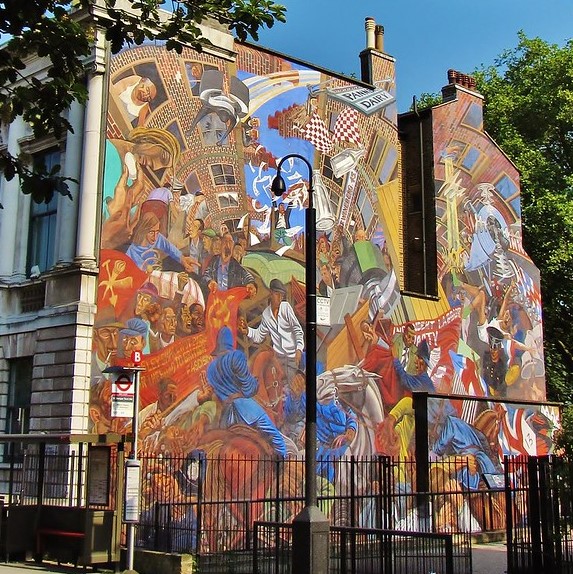
Between these groups stood the thin blue line of police. And they had also come out in force. The situation developed into a powder keg just waiting for a flashpoint. And it came from the anti-fascist supporters who began to hurl rocks and stones at the police lines. There were sporadic clashes in various parts of the area but the main one occurred in Cable Street. Pretty much open ware-fare broke out and the police said they had no option but to bring in the mounted officers who rushed the crowds in order to disperse them. Such was the chaos that it is reported that people living in Cable Street opened their windows and threw rotten vegetables and even the contents of chamber pots at whoever was in the firing line.
At the end of the disturbance or riot if you prefer, the police arrested over 150 protesters. But they had achieved their aim; the march had been stopped and it had to be abandoned. This was just one of many confrontations over the years but few could compare to Cable Street. Today, if you walk down Cable Street you will see a huge mural taking up the whole of one side of a building depicting the Battle of Cable Street.
 John Pullen