London is used to demonstrations and it has to be admitted that a minority of them can turn violent. And of course, London is not by any means the only city to experience such events. The Northern Ireland issue which has in one form or another, lasted for hundreds of years, has suffered its own share of violent demonstrations, much of it in Northern Ireland itself. From 1969 to the Good Friday Agreement of the 1990s, the period was known as the “Troubles.” And one of the worst violent demonstrations in Belfast became known as Bloody Sunday. A number of demonstrators were killed by British soldiers. There is still much discussion about this event. But, that wasn’t the first Bloody Sunday and this one happened in London.
Once again, it was the Irish question which prompted the demonstration. It was the 13th November 1887 and the Irish National League along with the Social Democratic Federation had organised a march through central London. The reason was once again, to argue about the policies governing Northern Ireland but also to get the release from prison of the Irish Nationalist MP William O’Brien.
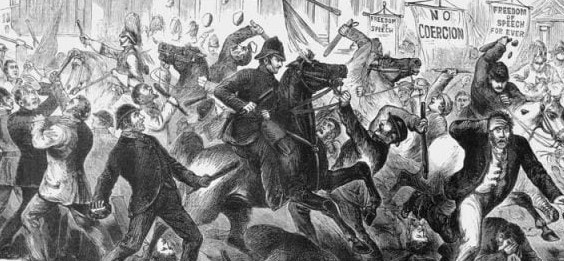
Being afraid that violence might erupt, both the Home Secretary, Herbert Matthews and the Police Commissioner, Sir Charles Warren issued instructions that the march should be stopped. This meant that the Metropolitan Police would have to stop them from entering Trafalgar Square.
The march reached the edge of Trafalgar Square and met a heavy police cordon. Three of the leaders of the demonstration made themselves known to the officer in charge and argued that they should be allowed to continue into the Square. This resulted in two of the leaders being arrested. It was at this point that things began to turn ugly. In response, the police brought in mounted officers who charged the crowd in an attempt to disperse them.
This resulted in at least three deaths and hundreds of protesters being injured. This led to many questioning the original decision to halt the march at all costs. When one looks at the numbers of police involved, it seems that there was not going to be any compromise. For it has been reported that on that day, 2,000 police and 400 soldiers has been tasked to stop the march. Today, much more thought and preparation is put into such demonstration planning.
 John Pullen