Perhaps over the years, if we ask the question of which drinks sum up the British or in this case, the English, it might be the pint of real ale in a country pub or for maybe those wishing for a spirit, the gin and tonic. If you watch old movies, drinking a gin and tonic or a pink gin seemed to be the favourite of what to be termed the “officer class.” This is of course pretty outdated these days and in fact, gin has in recent years, become much more popular with many people.
But, this wasn’t always so and gin has a history which gives us a very different picture from what is described above. For a start, gin is not a British invention. It was a Dutch drink and didn’t really appear in Britain until 1689 when William III came to power. He was Dutch and he brought this juniper-flavoured alcoholic beverage with him. At the time it was called genever.
It was soon a great success by those close to the king. Seeing this, William decided to make it available to the poor of London. Whether this was out of the kindness of his heart or a way of keeping them quiet is a mute-point and you can make your own mind up. But the effect of this decision had both dramatic and tragic consequences. As part of making it easier for the masses to partake, William allowed anyone to distil the drink and sell it on if they wished. For those who were poor and only used to watered-down beer, this new strong spirit which was cheap and easy to produce, soon left its mark.
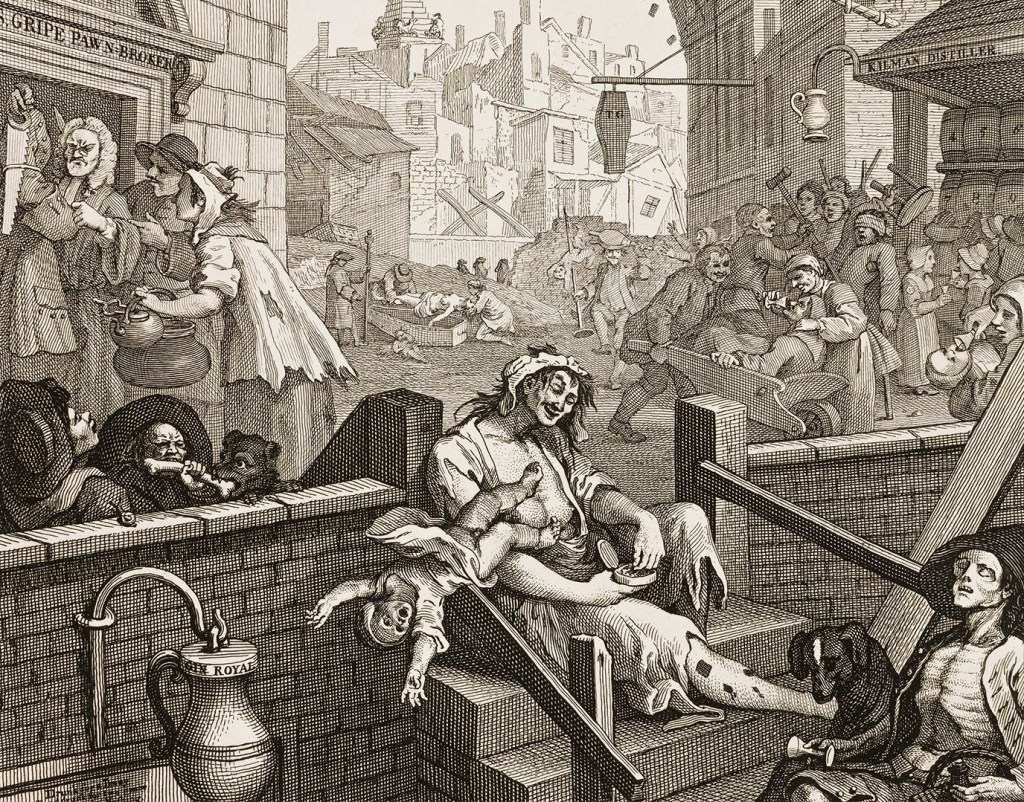
Barely 40 years after its introduction, there were over 7,000 gin shops in London. Out of these, it has been estimated that one in four private households made and sold the spirit. To be honest, because the poor had very little to their name and there was little chance to indulge yourself in any leisure pastime, the only thing left was to get drunk, very drunk. Like many who come under the influence, it took away the realty of the desperate lives they led.
Although it was drunk by both men and women, it was the latter who appeared to suffer the most. The drink became known as “Mother’s Ruin” which succinctly described the effect on most. The saying “Drunk for a Penny, Dead Drunk for Tuppence” became a good description of the state of affairs. It was becoming obvious to everyone that William’s original decision was backfiring badly. Unemployment soared because no one was capable of holding down a job and of course, over time, the death rate increased with drink-related conditions.
By 1743, it has been reported that 11 million gallons were being produced in London each year and that apparently was equal to 14 gallons for each adult male. No wonder there were so many deaths and unemployment. The government of the day knew something had to be done. They passed a number of Acts of Parliament in order to contain the problem. Eventually, it came down to putting up the price of gin so that the poor could not buy much. Private distillation was also banned. So, what effect did this have? It led to riots in 1743 just because gin was about to be taken out of their grasp. It sounds like London went through one almighty gin party for one last time.
 John Pullen