In 2023, Price Charles was coronated as King Charles III at a service in Westminster Abbey which, with a few exceptions, has seen such coronations for over 1,000 years. Besides some new innovations, many parts of the service have survived from the beginning. And one of these is the Stone of Scone or as it is also known, the Stone of Destiny. It is normally kept in Edinburgh, Scotland and has served as a sign of the “seat of power” for Scottish kings being crowned in Medieval times.
For the coronation of Charles III, it was brought down from Edinburgh to London and placed under the thronal chair on which the king was crowned. It is also true that Ireland has its own who were coronation stone on which the ancient Kings of Ireland were crowned. It is called the Lia Fail and these coronations took place at the Hill of Tara.
It may seem a bit strange that the coronation of King Charles III needed the presence of the Stone of Scone when in actuality, England has its own coronation stone which is not used. This one is called the King’s Stone and is kept in Kingstone upon Thames just to the west of London. You might think that this must be the origin of the name of Kingston, but this is not correct. The name of Kingstone comes from the original name of the town which was Cyningston. This translates to the “King’s farm or settlement.”
There have been seven coronations performed in Kingstone but took place over 1,000 years ago. The seven kings who were coronated there are in chronological order:
Edward the Elder 899CE
Athelstan 924CE
Edmund 941CE
Edred 946CE
Edwy 955CE
Edward the Martyr 975CE
Ethelred the Unready 978CE
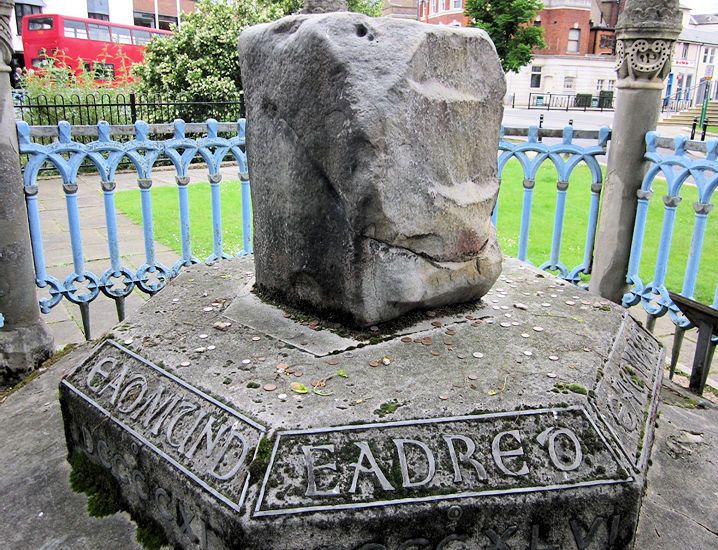
Over the years, the stone had had a number of homes in Kingston. It was first installed in the Saxon Church of St Mary’s. But, when the building collapsed in 1730, the stone was moved to the Market Place. This did nothing for the dignity of the stone’s history as it was then used as a mounting block to get up on and off your horse. This lasted until 1850, when it was again moved; this time a little south and then fenced off from the public, so no more standing on it. It also had a plaque installed giving the names of the seven kings who it helped to crown. In 1935, it was again moved. This time to outside the Kingston Guildhall. And that is where it remains to this day.
 John Pullen