The Periodic Table lists all of the elements we know that exist. The Russian chemist Dmitri Mendeleev is generally credited with coming up with the idea of the Periodic Table in 1869. It begins with the simplest element which is Hydrogen, followed by Helium and climbs to Uranium at number 92. The numbers refer to the number of protons within the nucleus of each atom. The first 92 elements are characterised by occurring naturally in nature.
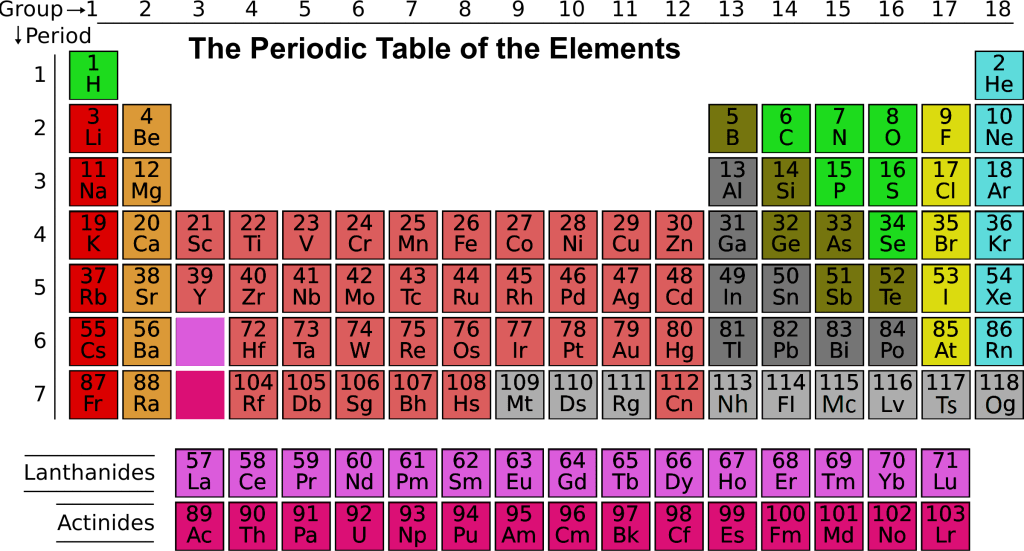
But that is not the end of the table. Further radioactive elements exist up to the number 118. It begins with Element 93 which is Americanium and the element which occupies the 118 position in the table is Oganesson. These latter elements do not occur in nature and have to be synthesised in a laboratory. As we proceed higher up the table, it gets harder to produce these elements.
Number 99 which is Einsteinium, is the heaviest element that has been observed in a macroscopic size when in its pure form. Others can only be seen by the light emitted from minute quantities of them. So, is that the end of the story? Judging by the title of this article, the answer is possibly not.
There are other theoretical elements which go up to 137. These are hypothetical and so have not been discovered. They form what is termed the Extended Periodic Table. Why 137 and not a higher number, you may ask? Theoretical physicists speculate that the electrons which exist outside of the nucleus of an atom would have to travel at the speed of light, which we believe is impossible in this situation. The name given to element 137 is Untriseptium.
This is all based on the speculation of some physicists including the legendary Richard Feynman, in the following way. Protons and electrons are bound up by interacting with photons. A photon is a unit or packet of light. It is thought that at number 137, there will be 137 protons and 137 photons. The theory then postulates that a single electron will absorb a single photon. Therefore, it is thought that there would be a 100% absorption. In other words, the electrons would have to travel at the speed of light.
 John Pullen