The Moon is covered in craters. These have been made by the millions of meteors that have crashed onto the surface over the past several billion years. Because the Moon does not possess an atmosphere, the incoming rocks do not burn up as most do when entering the Earth’s atmosphere. Therefore, there is nothing to stop them from impacting. Their sizes vary from a few centimetres across to many kilometres.
Another aspect of the Moon which has been favourable to astronomers is that it is a dead world. In the distant past, it would have been active with volcanic eruptions and vast lava flows, the remains of which can be seen today as the “Seas” or “Mare.” Therefore, in a dead world, things should remain the same except for further meteor strikes and a few humans tramping around the surface fifty years ago. Of course, there will be new footsteps made in the next few years as we revisit the Moon with the intention of setting up a permanent base there.
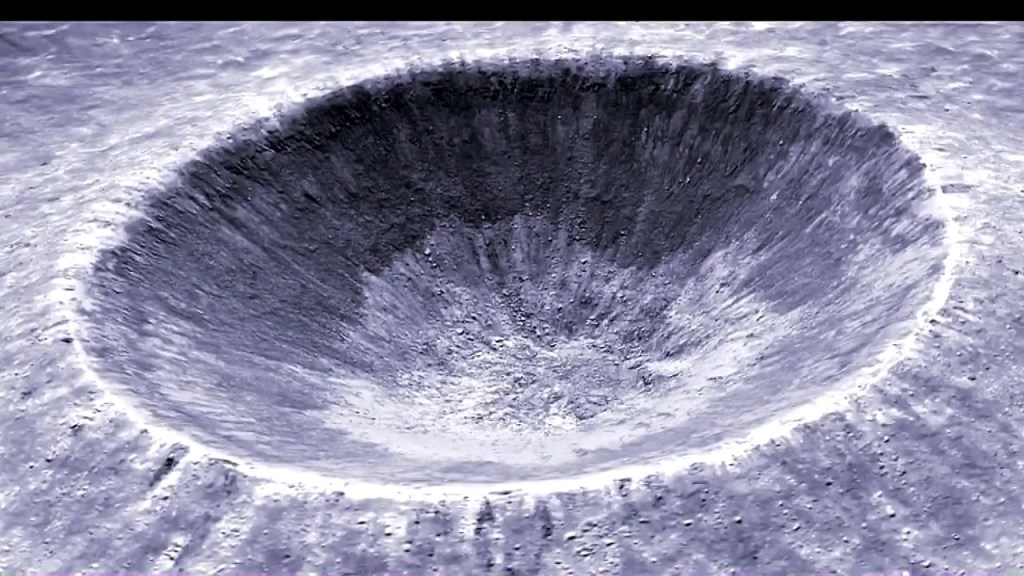
However, is the Moon really dead? There is a crater called the Linne Crater which was named after the famous botanist and zoologist Carl Linnaeus. In 1866, the renowned German astronomer Johanne Schmidt detected a change in the Linne crater. He reported that it had appeared to have changed shape. At the time he was in charge of the Athens Observatory in Greece and had produced the best map of the lunar surface to date. So, he was someone who would be listened to.
Interest became focused on the Linne crater for several decades as to why it appeared to have changed shape. Unfortunately for Schmidt, no definite proof of a change could be found and so the general opinion was that this was due to defects in the optics of his observation telescope. However, recent observations have once again raised the question of whether there is something going on in this crater.
There is now a new theory that states that the “changes” observed in 1866 were due to what is termed “outgassing.” If correct, then it does mean that the Moon is not completely dead, just in a deep coma. Such emissions of gasses from beneath the surface could distort the view of the crater. It is suggested that in 1866, there might have been a large outgassing event which Schmidt observed.
We do not know for sure what the reason is but with our return to the Moon in the next few years, it will be another question we should be able to answer fully.
 John Pullen