First of all, an important warning. Whenever you try to observe the Sun you must use the correct protection such as special solar viewing glasses or if using a telescope, you have to use a sun dioptre or project the image onto a sheet of paper. Take advice from a qualified person. Even a short exposure to direct sunlight through a device will result in blindness.
If you are able to see the Sun safely or better still, view some photographs of the Sun, then you might notice a number of dark spots on the surface. These are called sunspots and are areas of planet-size proportions of cooler areas. The average temperature of the surface of the Sun is 6,000 degrees Celsius whereas the sunspot is approximately 3,500 degrees Celsius. They are also areas of strong magnetic fields and these can be responsible for creating solar flares or coronal mass ejections. These can be seen as solar prominences being thrown out into space.
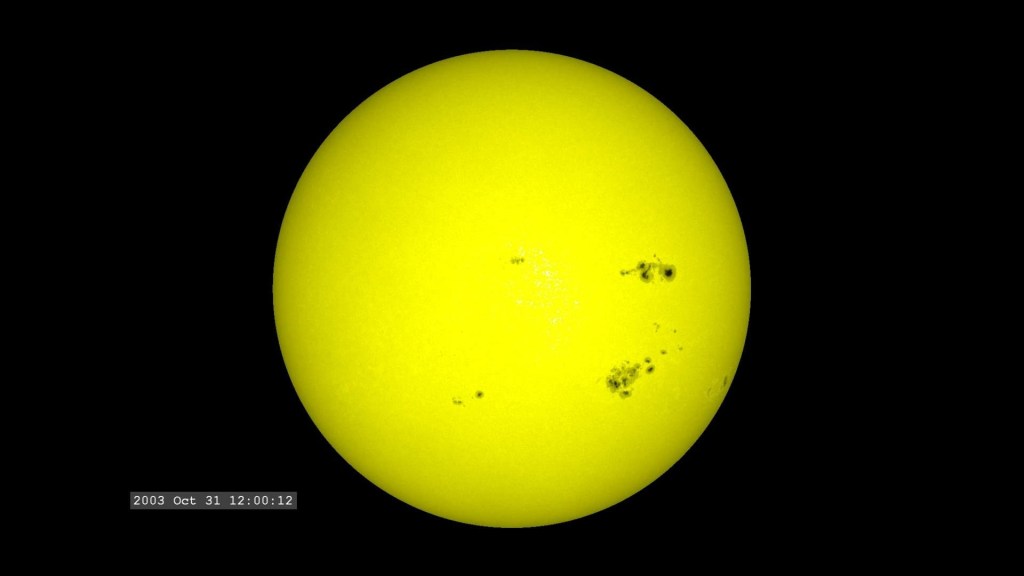
Sunspots are part of an 11-year solar cycle which is due to the Sun flipping its magnetic poles at the same rate. What this means is that the north magnetic pole of the Sun becomes the south one and vice-versa. The flip itself takes about a year to complete a flip. During this time, sunspots are at a minimum. After the magnetic fields become stable, sunspots will start to appear.
The largest number of sunspots occurs when the Sun is said to be at a solar maximum. They tend to congregate on a latitude of 30 degrees north and 30 degrees south. As the cycle moves towards the solar minimum, the sunspots begin to reduce and move towards the equator. The total sunspots observed vary between 12 at minimum to about 100 during the maximum solar cycle.
We have to be aware of sunspots as if they should cause a large coronal mass ejection, then the radiation can have effects on our world. On the plus side, it gives us increased Aurora Borealis light shows. But on the negative side, they can fry the circuits of some satellites. Our own magnetic field protects us from this radiation but during these periods the crews aboard the International Space Station have to take cover in a specially protected module. Flights to Mars in the future will take up to eight months so crews will also have to be protected.
 John Pullen