In 1773, a tiny creature was discovered by a German zoologist named Johann August Ephraim Goeze. He named it the “little water bear.” However, three years later, it was renamed the Tardigrade which it is known as today. Some people describe its looks as cute, but I shall let you decide after looking at the picture below. But, it is an astounding creature. They are aquatic creatures with a plump body which is segmented. It has a flattened head, and at the end of each of its eight legs, there are four to eight claws.
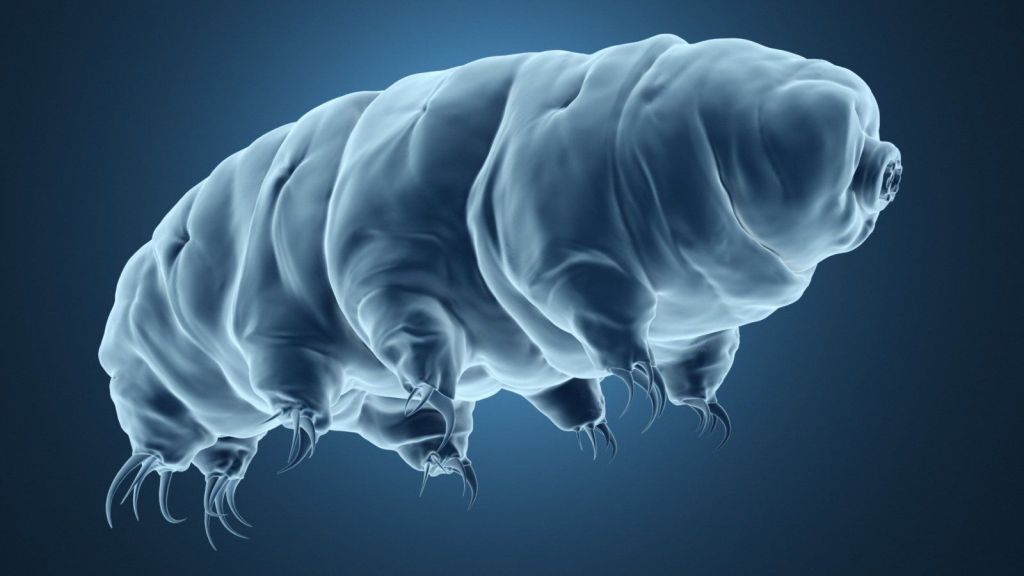
There are two aspects to the tardigrade which makes it pretty unique amongst the animal world at its broadest description. On average, it is only about one-and-a-half millimetres in length but it is perhaps the ultimate survivor. There are over 1,300 different species of the tardigrade and they can be found almost everywhere on the planet.
But it is their ability to survive extreme environmental conditions that is exceptional. Regarding temperature, it has been shown to be able to survive temperatures just above absolute zero. This is a point where all kinetic energy becomes zero and is equivalent to minus 273 degrees Celsius. At the other end of the temperature scale, tardigrades can survive over 150 degrees Celsius. This all means that they have been found living at the bottom of oceans and high up in the Himalayas. In addition, they can survive in polar regions and on the Equator.
They have successfully travelled into space but their ship crashed onto the lunar surface in 2019. There is some debate about whether a few of them may have survived the crash and lived for a time on the Moon. It does not stop there either. It has been shown that they can survive radiation doses thousands of times higher than would normally kill other animals. Finally, they are able to go without water for up to ten years.
Part of their secret is that they are able to shut down their metabolism. However, the latest research shows that they do have a weakness and it is one that climate change may be the reason why they could die out in the future. Although they can stand high temperatures, they cannot survive if the water they are living in rises above about 38 degrees Celsius. This data should be another warning as to how serious climate change is.
 John Pullen