Across the world, there have been tales and legends of creatures living in places which are hard to explore. We have Bigfoot in the forests of the USA and the Loch Ness Monster supposedly hiding under the deep waters of the loch. Any evidence of these and other creatures is either open to debate as to their authenticity or is false. I do not believe in Bigfoot or the Loch Ness Monster.
But can the same be said of the Yeti or Abominable Snowman? It is said to be a hairy creature which can stand and walk on two feet; rather large feet if we can believe the footprints found. If they do exist, then it is the Himalayas and the mountains of Asia which have given them the ability to hide from humankind.
The first “evidence” of the Yeti was found by the Mount Everest Reconnaissance Expedition of 1921. When the expedition returned, a reporter working for the BBC interviewed them and learned of a story which would catapult the legend of the Yeti into worldwide attention. They told the journalist that they had discovered very large footprints in the snow. When questioned, their guides explained that it was made by a “metoh-kangmi” which meant “man-bear snow-man.” Unfortunately, something was lost in the translation and the “Abominable Snowman” name was coined and stuck.
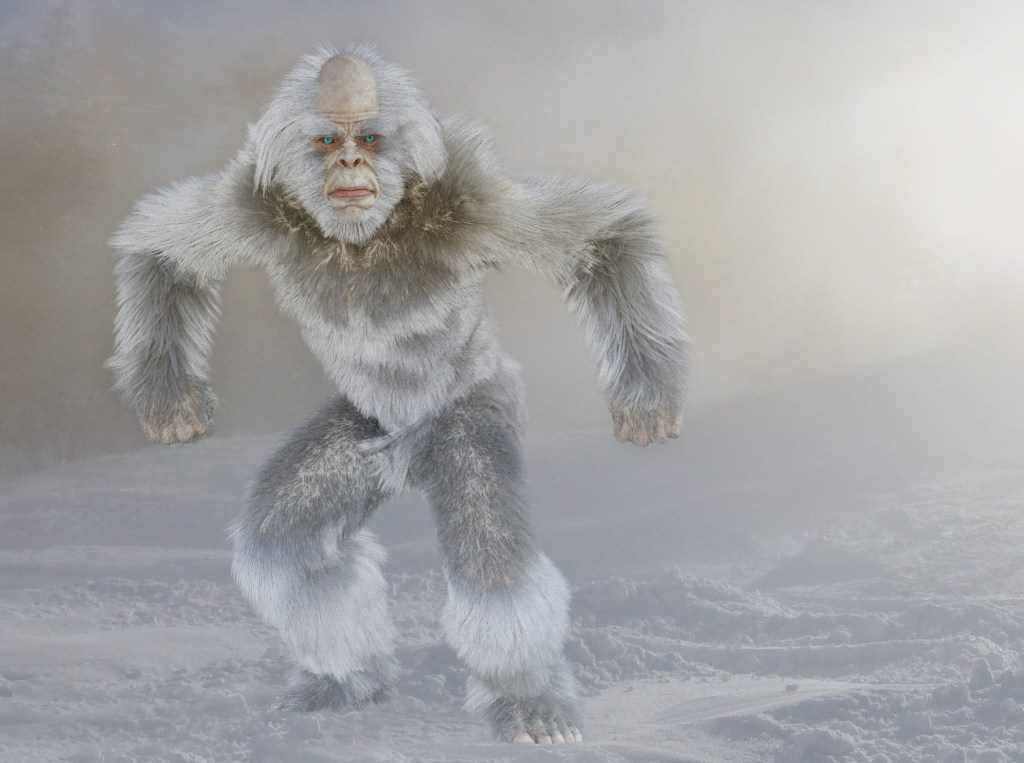
Other sightings would follow over the years including in 1942, when two hikers reported seeing two large creatures, perhaps eight feet tall, walking about a quarter of a mile from them. They further stated they had squarish heads and were hairy. However, their first remark was that what they saw two black spots walking. There is no evidence that they got close enough to make such a detailed description. Questions like this often arise when witness statements are analysed.
Other sightings have described a smaller, red-haired creature pulling up bushes and making a high-pitched cry. One more reasoned opinion was made by the famous climber Reinhold Messner who thought that these sightings were often of a large bear. Personally, this is my belief if there is an answer to this.
Then in 1986, another hiker saw a tall creature standing about 500 metres from him. It didn’t move or make a sound. He was able to take two photographs of the creature. When these were analysed, the judgement was that they were genuine. The hiker was an anatomist and an experienced anthropologist, so he had a reputation which needed to be taken into account. However, further analysis of the pictures showed that he had taken photographs of a black rock. It was a mistake caused by the light. There was no suggestion of anything more than a genuine mistake. But it does show how easy it is to get things wrong in these circumstances.
In 2010, the Chinese captured a Yeti which turned out to be a civet cat. A finger allegedly from a Yeti was analysed in 2011 and found to have been human, probably from the corpse of a monk.
In 2011, a geneticist from Oxford requested any samples of Yeti stored anywhere to be sent for DNA analysis. It brought in 57 samples of which 36 were tested. Most were assigned to be parts of known animals. There was one which indicated to have come from a polar bear which lived over 40,000 years ago. Unfortunately, further analysis proved this was not the case but possibly the prodigy of a polar bear and brown bear. You have to be so careful even with DNA evidence.
So far, all DNA evidence shows all the samples can be identified as coming from known species. Once again, my personal belief is that the best sightings are of large bears.
 John Pullen