It is no surprise to know that many of the animals we know today, had prehistoric ancestors which were much larger but still recognisable to what we see today. Among these was the kangaroo. None of them exist today and have not been around for tens of thousands of years. Modern kangaroos are common in Australia and ask anyone to describe some aspect of them and you will probably hear that they hop and keep their young in a pouch. One or two of them may remark that they are good boxers, but we will not go down that route as like most “animal” sports, they are cruel.
But back to the giant kangaroo. They roamed around the outback of Australia between about 100,000 to just 30,000 years ago. Professor Christine Janis of Brown University in Rhode Island has made a study of them. Her research carried her around the world in order to analyse the remains of such creatures kept in various museums.
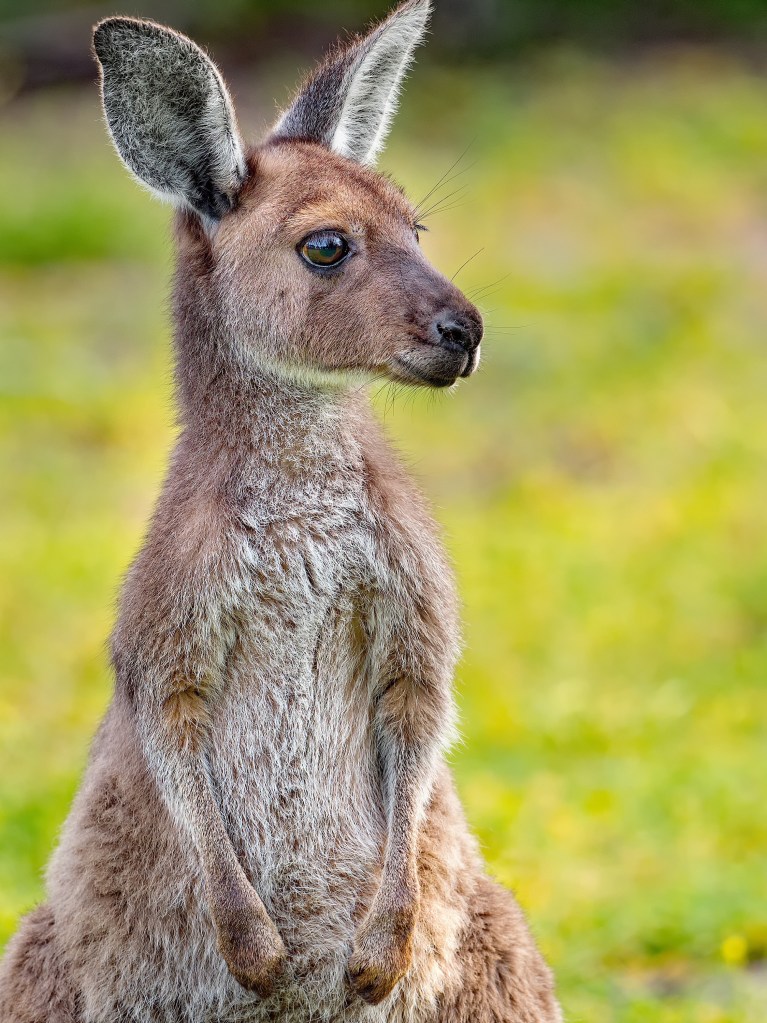
Modern Kangaroo
These giants were part of a family group by the name of sthenurine marsupials. Janis’s research concluded that they grew up to three metres or ten feet in height. They weighed up to three times the weight of a modern kangaroo. The largest specimen found, known as Procoptodon goliath, was believed to have weighed in at 240 kilogrammes or 529 pounds.
Examination of their bones showed that they would have stood on two legs. There was another important difference to modern kangaroos. Because of their weight, it is unlikely that they would have hopped, but instead, have walked. Another clue was their teeth. They indicated that they ate the leaves of trees and shrubs rather than grazing on grasses as the modern red kangaroo does.
Professor Janis has remarked that she believes modern kangaroos are more like big cats like the cheetah rather than like their ancestors. This is because modern kangaroos are slim, fit and streamlined in order for them to be able to move quickly. That leaves us with the question of why the giant kangaroo died out. The two theories are that they died out because of climate change (where have we heard that before?). Evidence to back this up is that several other large species such as wombats weighing up to two tonnes and crocodiles, which have not changed much since prehistoric times and were up to five metres in length.
As a personal point, I have never liked crocodiles since I almost stepped on one whilst on a filming job in Malawi, Africa. Many years later, under guidance, I swallowed my fear and patted one. I had been assured that it had just eaten!
The other theory says that it was possibly humans hunting them to extinction. There is also evidence for this as an examination of the teeth of some giant kangaroos show the remnants of drought-resistance plants and shrubs indicating that humans were likely to be the culprits.
 John Pullen