There have been many archaeological discoveries which have surprised those who found them. But, in a remote part of the country of Laos, in the Far East, a discovery was made that still has many historians scratching their heads. In 1923, an archaeologist by the name of Henri Parmentier visited a plain containing thousands of large stone jars. Although it the area is called a plain, it is actually quite a hilly region.
The extent of these jars were found to be spread over 100 square kilometres and were grouped into about 90 separate sites. The jars were large; many of them being three metres or ten feet tall. They weighed in at around several tonnes each. The vast majority were empty, though some of them contained some human bones, glass beads and some bronze bells. The finding of some human bones helped to confirm what some researchers believed was the real purpose of them and that they were burial jars. Evidence for this came from Indo-China where similar jars were used for that purpose.
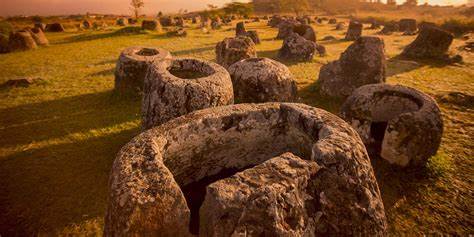
Others believe that the jars were for storing alcohol. I find that difficult to believe as it would make the builders all alcoholics! However, the locals have an answer to this. They have a legend that says they were the alcohol containers for a tribe of giants. It is also thought that the jars may have once had lids, but none have been discovered. We also know that similar jars were found 600 miles away in India but we can find no link between them. We do not even know who made them. But we do believe they appeared between 500 BCE to 500 CE, making them about 2,000 years old.
We are quite fortunate to still have most of them intact. During the Vietnam War, American aircraft dropped 2 million bombs on Laos. The Plain of Jars is to this day, a dangerous place to tread unless you follow the carefully marked out trails in order to see the jars. There are still many unexploded bombs in the area along with live landmines. However, it is still the most popular tourist attraction in Laos.
 John Pullen