As every school pupil should know, the Battle of Hastings took place in 1066 (actually, on the 16th of October), at a place close to Hastings now called appropriately Battle. It resulted in Willian the Conqueror becoming King of England. The time of Anglo-Saxon rule had come to an end. The former king, Harold was said to have been killed in the battle by an arrow entering his eye. This cause of death has been disputed.
Obviously, after being invaded by William, Duke of Normandy and installing himself on the throne of England, not everyone was overjoyed. One of these people earned the name and title of Hereward the Wake. For Star Wars fans, he was one of the leaders of the Rebel Alliance! For everyone else, he was not prepared to bow down to the new invaders.
He was born in 1035 in the English County of Lincolnshire. He spent most of his time roaming around what are termed the Fens. These are fairly flat areas of land which today would be located in the counties of Cambridgeshire, Lincolnshire and Norfolk. They are located roughly 100 miles north to north-east of London.
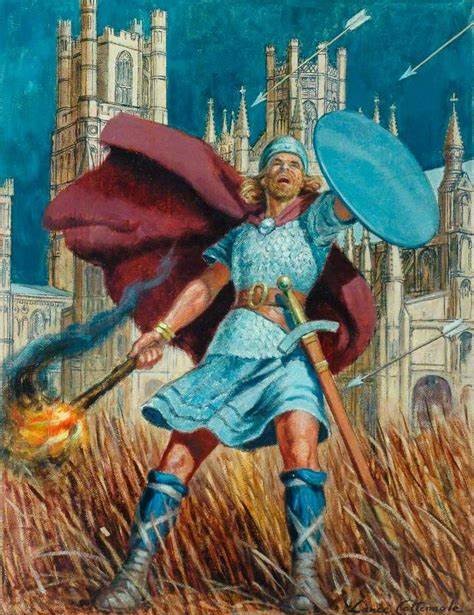
He came to attention in 1070 when he joined a group of Danish sailors located on the Isle of Ely (about 20 miles north of Cambridge). They were concerned that the Danish king Selwyn II was about to invade. They travelled to Peterborough and sacked the abbey there. Their excuse was that they were worried that the new Norman Abbott would do the same thing and they wanted to keep the treasures out of Norman hands. The Isle of Ely became the base for Hereward’s operations.
It would be just a year later, in 1071, that the Isle of Ely became the final refuge for the Anglo-Saxon rebels. It came under siege by Morcar, the Earl of Northumbria. Eventually, the forces of Morcar overcame the rebels. It is said that Hereward managed to make good his escape by taking to the water.
What then happened to Hereward the Wake is not known. However, we do have three different accounts, one of which may be correct. The first is that he was eventually cornered by Norman knights and after a fight, he was killed. Another has a very different ending as it says that William the Conqueror pardoned him and he was able to live out the rest of his life in peace. The last theory is that he continued to thwart the Normans and lived out the rest of his life in exile. The truth is, we do not know for sure.
It may be questioned why Hereward should appear to be a person of greater interest than the facts would suggest. The reason for this is that in 1865, Charles Kingsley, the Victorian author, wrote a romantic book about him and his exploits. This made him a hero of his time and from then on, Victorian schoolchildren were taught about him. I was also taught about him during my school days.
 John Pullen