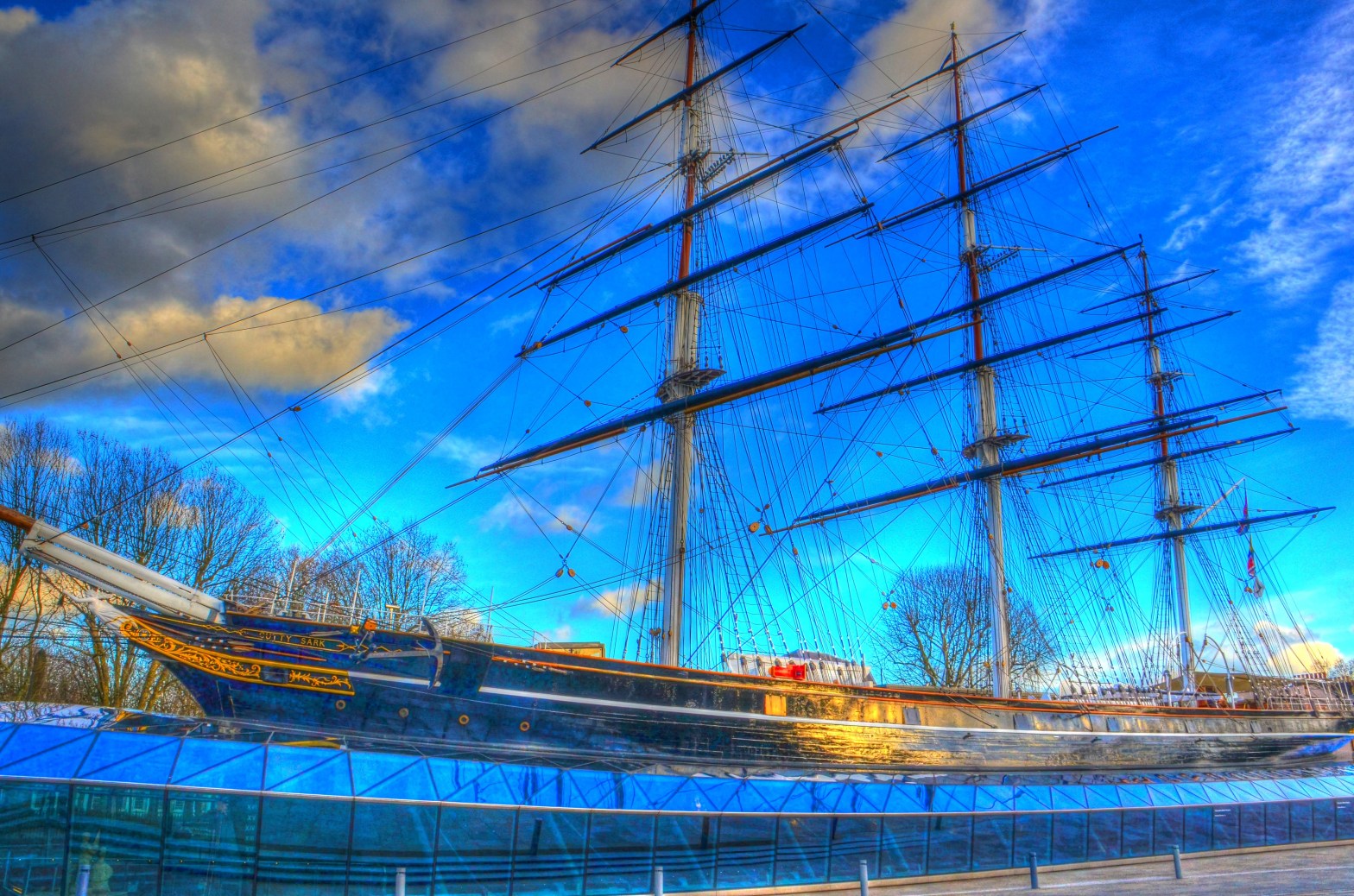
One of the most interesting sights to see today in Greenwich, London, is the ship, the Cutty Sark. It sits in a specially built dry dock besides the Thames and close to the old Royal Naval Hospital. It is a museum and you can go on board and inspect its upper and lower decks. You can, if you pay some more, climb up the rigging, under supervision of course. But what is the history of this ship and why is it such a spectacle today?
To answer this, we need to discuss the effect that tea drinking had in the late nineteenth century. Tea was as popular then as now and it is grown in the Far East or India and Sri Lanka. There was therefore a race between tea clippers as these ships were known, to get the first tea of the new season back to England. In the case we are going to discuss, the race was between Cutty Sark and another clipper, Thermopylae.
They both sailed on the same tide from Shanghai, China, on the 18th June 1872. Such races were common and it wasn’t all for glory. The first to arrive meant that there were bonuses for the ship owner and the crew. On this particular race, the Cutty Sark had soon extended its lead to 400 miles from the Thermopylae. But, misfortune was about to hit her. Rounding the Cape of Good Hope on the 15th August, the Cutty Sark lost her rudder. This would not have been unheard of as the Cape was known for storms and bad seas.
There was a discussion as to what to do. Some wished to get to Cape Town in South Africa in order to make repairs. But the captain refused and instead they made enough of a repair to continue to sail to their destination which was London. Of course, their loss of time and the hindered performance meant that the Thermopylae beat her by seven days. Although the Cutty Sark lost, it still received a lot of praise because of what she had achieved.
The Cutty Sark continued to partake in racing tea from the Far East to London until 1890. It then retired from tea and began life again as a general cargo vessel. It then became a training ship until in 1954, it retired to its dry dock in Greenwich. Unfortunately, disaster struck in 2007, when the ship caught fire. Much of it was severely damaged but there was a stroke of luck too. At the same time much of the fittings including the figurehead had been taken away for repair. The ship was rebuilt and the original fitting once again installed where they remain.
 John Pullen