The Battle of Hastings in 1066 is perhaps the most significant event in the history of England. William the Conqueror landed on the south coast with his Norman army and met the English forces under King Harold nearby at a site which became known as Battle. You can visit it today and it has an abbey there.
However, as famous as the battle was, there are many unknowns attached to the event. For example, how many soldiers did each army have when they faced each other? Historians differ in the number but it is thought that the invaders had anything from 4,000 to 20,000 fighters. Facing them, it is believed the English had between 7,000 to 8,000 defenders.
Besides losing the battle, perhaps the most famous or infamous part was the death of King Harold. It is said that he died when an arrow entered his eye. Although this has been taught in schools for many, many years, there is no definitive proof that this happened. The main source of evidence for the battle is contained in the Bayeux Tapestry.
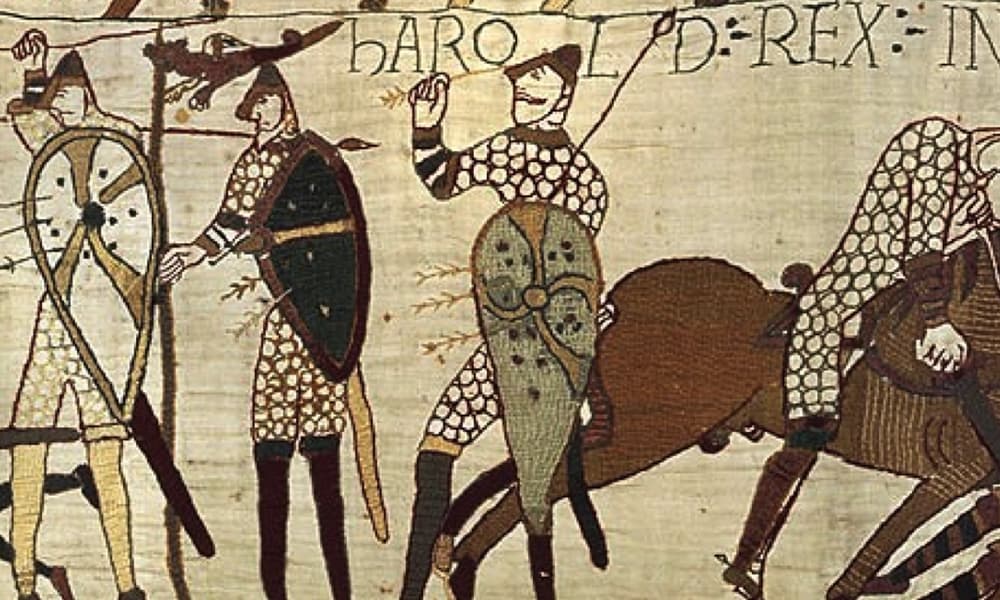
To tell the truth, it is not even a tapestry, but an embroidery. Don’t ask me exactly what the difference is! I have been to see it and it is quite a sight. But how true the depictions are, we do not know. For a start, it was not made until 11 years after the battle and we do not even know who commissioned it. Some believe it was the wife of William, Queen Matilda.
Others say it came from William’s brother, Bishop Odo. He was the bishop of Bayeux cathedral, so there may be a connection there. Another theory states that the work and some of the letters are more like those used in England. All of these are possible. Being 11 years after the battle, it might have even been embroidered in England and moved over to France. However, the first record of it doesn’t come until 400 years later in 1476 when it is listed in an inventory of Bayeux Cathedral. Where it was before that, we do not know.
There is another mystery surrounding the Battle of Hastings and if true, it could have turned the battle and indeed, the whole history of England for the next 1,000 years. It was known as the Malfosse Incident. Malfosse means “evil ditch”. We have up to five accounts of the incident which may give it some weight. It says that the English were in full retreat towards the end of the battle. It was decided to make a last stand at Malfosse as the ditch gave them some defence.
The story goes that both William the Conqueror and his Norman army commander, Eustace of Boulogne, were conferring on the battlefield. An English soldier was lying nearby. We do not know if he was injured or pretending to be dead. But, he saw the two close by, It is then said that he threw a large rock at them, hitting Eustace in the back. The blow was so hard that he spurted blood out of his mouth and died. If he had hit the other person, then there would have been no William the Conqueror on the throne and history may have taken a very different turn. Who knows? Another mystery is that we do not know exactly where this Malfosse ditch is.
 John Pullen