What a strange question, you may ask? Of course, colour exists. Just take a look around you. The sky is blue. The grass is green and almost everything else has a colour to it. But to discuss this in more detail, we have to understand what colour is and more importantly, how our brains decide which colour is which. It is not as simple as just looking and deciding that this is red or that is blue.
The visible spectrum of the electromagnetic spectrum of energy or EMS for short, occupies a tiny set of wavelengths within the EMS. It is known as the visible spectrum because it is the only part of the EMS we can see with our eyes. We measure parts of the EMS by its wavelength. The shorter the wavelength, the higher the energy and vice versa. Red has the longest wavelength and violet the shortest of the visible spectrum. Beyond red we have infra-red and radio waves. On the short end of the EMS we find ultraviolet and gamma rays to name a few.
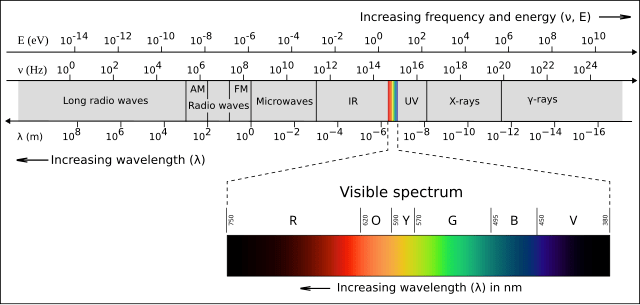
Therefore, colour is assigned to a particular wavelength. When we “see” an object, the “rays” from the object travel to the eye and enter it. Our eyes are very complicated, but on a simple level, we have two parts which are receptive to these wavelengths. In the centre of our eyes are cones and these are sensitive to colour. Around them, are rods which are not really colour sensitive, but are important when it is dark. You can prove this by looking at an object in a darkened room. There will be little or no colour, but if you look at the object from the side and not directly at it, the object will look clearer. This is because the cones are in the centre and the rods are to the sides.
There are three types of cones. One type is sensitive to longer wavelengths such as red. Mid cones are sensitive to greens and short cones are sensitive to violet. These wavelengths enter eye and are changed by the cone receptors into electrical energy and transported to the visual cortex in the brain via the optical nerve at the back of the eye. These wavelengths and electrical impulses are not coloured. It is our brain which interprets the incoming information and “converts” it into something we call colour.
Because we have three types of cones, the brain can receive light of different wavelengths. For example, receiving long and mid wavelengths give us yellows and orange. Short and long can produce such colours as teal. Questions have been posed such as do we see the same colours? In other words, is my red your red? It’s a good one. However, one would suspect our brains work in a similar way due to evolution and so they should be close to delivering the same perception.
However, there is another question which has been posed and that is whether some colours do not exist at all in nature. As an example, let us take the colour purple, (not the movie of that name). You might straight away say that there are many examples of purple in the world. But do they exist? The reason for this is that purple is a mixture of red and violet. In other words, they are from opposite ends of the visible spectrum.
This means that to bring the two together, the visible spectrum has to become a “circle”. This produces the perceived colours of purple and magenta, and these do not exist as separate wavelengths. They are called non-spectral colours, meaning they do not have their own wavelength. Spectral colours such as red, green and blue do. The conclusion to this is that purple, as a wavelength, does not exist in nature. But in our minds, it does, and that might just be more important.
 John Pullen