Some people are born with a brain disorder known as Chari Malformation Type 1. It is recognised by the brain, pushing the skull outwards. This is seen as a bulge at the rear of the skull. It was diagnosed in the nineteenth century by an Austrian pathologist, Hans Chari. It was first thought that it affected around one in a thousand, but recent analysis shows this to be closer to one in one hundred. So, why are we not so aware of it? It is because when the condition is not very pronounced, it is often overlooked. It can be treated with muscle relaxants.
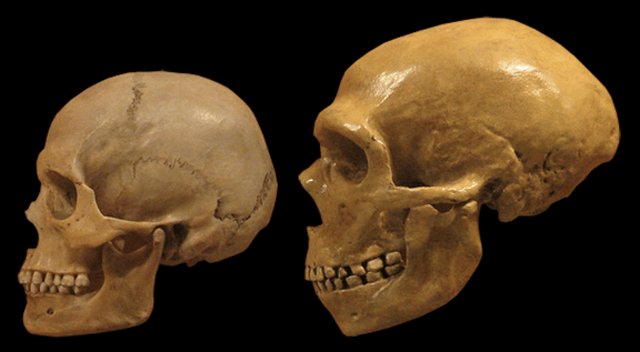
However, if it is pronounced, then more serious interventions have to be made. This can include surgery where part of the rear skull is removed to allow the brain to move into the space and sometimes interact with the top of the spine. In the most severe of cases, the condition can be fatal. So, where does our assistance from Neanderthals come into the picture?
Neanderthal skulls, some dating back 75,000 years, have been discovered to have the same bulge at the rear of the skull. This would appear to be an evolutionary aspect to their bodily structure. At this time, homo sapiens, the ancestors of modern humans, did not have this bulge or the condition. However, homo sapiens and neanderthals interbred and the genes associated with the bulge in the skull got passed on. Obviously, it only affects perhaps 1% of the population, which of course, is still not a small number, but it is a negative branch of evolution which affects some modern humans.
I suppose the tongue in cheek point to this is, Be careful who you sleep with, it might have consequences for your descendants in 100,000 years!
 John Pullen