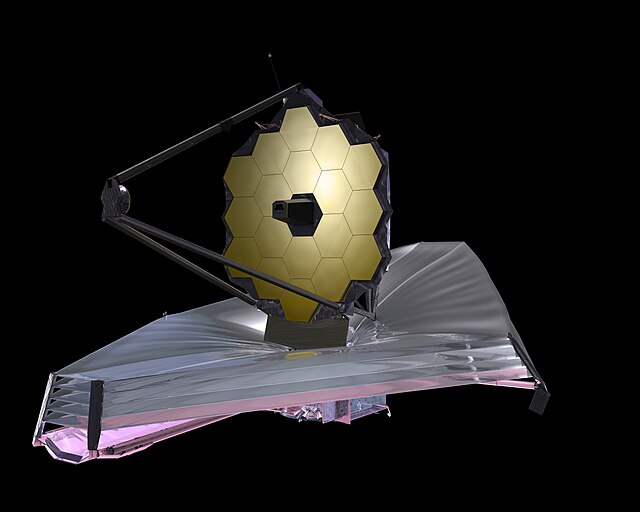
Okay, that is probably not completely correct, but we are getting closer and closer to witnessing the birth of our universe, in other words, the Big Bang. To be able to even contemplate getting close to this event, we have to use bigger and bigger telescopes and place them in very special locations in space. Currently, it is the James Webb Space Telescope or JWST which hold the record of being able to see further than ever before.
It is a pretty remarkable feat considering that it was only invented in 1608, by the Dutch glassmaker, Hans Lippershey. His instrument was only able to enlarge an object by a power of three. Today, astronomical telescopes are basically of two types; those that are located on the Earth and those that are situated in outer space. Land-based telescopes are usually found at the top of mountains such as in Chili and the Canary Islands. This is to cut down the thickness of the atmosphere it has to look through. Even at height, there are dust and other particles which degrade the ability of the telescope.
There are also differences to the type of wavelength which a telescope uses to “see” objects. They all lay along the electromagnetic spectrum of energy. The ones we are used to use the visible spectrum, just like our eyes. Others such as Jodrell Bank in northwest England are radio telescopes and use other wavelengths. The James Webb Space Telescope uses the infrared part of the spectrum.
Most od us have heard of the Hubble Space Telescope orbiting the Earth. That uses the visible spectrum and being above the atmosphere, is able to send back amazingly detailed pictures of far-off galaxies. When first deployed in orbit, it was found that a tiny inaccuracy in one of the mirrors was distorting the images. There was only one way to fix it and a space shuttle was launched and the astronauts aboard replaced the damaged parts.
The James Webb Space Telescope was launched in 2021 and has taken up a position a million miles away and on the other side of the Moon. The Moon is around a quarter of a million miles away from us. The telescope has to be positioned so that there is no undue gravitational forces acting on it. It needs to find a spot which is extremely stable. These points are referred to as Lagrange points and the JWST occupies one of them.
So, how close are we from seeing the start of the universe? Currently, we are seeing as far back as 98% to the beginning. Perhaps several moments to explain this. Our universe is expanding and accelerating. We know the universe began around 13.7 billion years ago. Those objects that were formed near the beginning are furthest away. So, the further we can look out into space, the further back in time we are looking at. We my never be able to the actual birth of the universe, but we are at the point where it is not even a toddler.

