From time to time, hurricanes occur in certain parts of the world. Indeed, some of these regions have hurricane seasons. It is also noticeable that due to climate change, hurricanes are beginning earlier and finishing later. They are more frequent and they are often more powerful than they were in years past. They can cause massive destruction and death. However, this article is not about any Earthbound hurricane, cyclone or tornado. This is about one large hurricane which occurred in 2014.
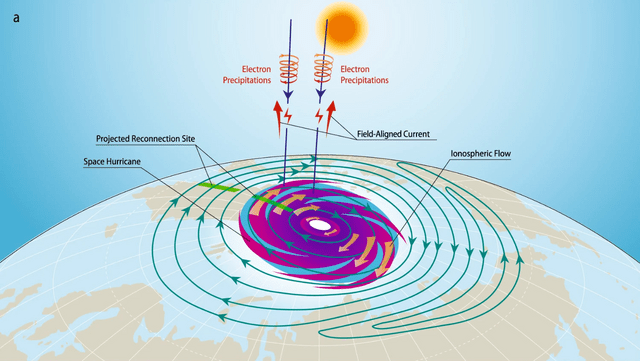
It was not in any one region of the world, but took place over the North Pole in space. This space weather phenomenon is now termed a “space hurricane”. Instead of massive air currents, a space hurricane uses plasma in the same way. These are rare. The one in 2014 lasted a total of 8 hours. It caused disruption to our magnetic field, which protects us from the harmful radiation from the Sun. From time to time, the Sun produces huge solar prominences which travel across space and interact with our magnetic field.
But on this occasion, the Sun’s activity was quiet. However, the effects were very similar. From a space weather’s point of view, it was as fierce as any Earthbound hurricane, but without the destruction of life and property. What it did do was to affect GPS signals and cause a large increase in electrons being ejected into our atmosphere. These effects can also affect other satellites, and those aboard the International Space Station or ISS, would have to be aware. There is a shielded area aboard the ISS for situations like this.
The storm was first picked up by a US military satellite, DNSP F17. This is designed to monitor space weather. A short time later, the European Space Agency’s Swarm B satellite flew through part of the storm. It was able to gather much information. It reported the hurricane was close to 1,000 kilometres across. It had a centre which was calm, just like the ones on Earth. Although first thought to be a rare event, new evidence now suggests that we might encounter up to 10 such hurricanes a year. They occur in both hemispheres and are usually present in the summer months. In some instances, say scientists, it is possible to observe their effects from the ground as you would view the Aurora Borealis or the Aurora Australis. Good luck.

